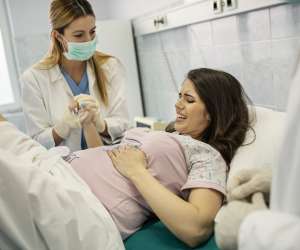
Many women have never been a patient in a hospital before the birth of their first baby, so they have absolutely no idea what to expect. The idea of even going to a hospital as a patient can be daunting. Fortunately, today's hospitals try to make the experience as "painless" as possible by offering all the comforts of home, and then some.
Should the Cart Come Before the Horse? If you have insurance (and here's hoping you do), then you may not have a choice of hospitals. Chances are good that you are limited by a specific list of preferred providers as to which hospital and health care provider (i.e., doctor) you can choose. However, being limited doesn't necessarily mean that you don't have a choice. Even if you have only two hospitals to choose from, go visit them in advance to see what they have to offer. Sometimes, women fall in love with a particular hospital that their doctor doesn't deliver in, and they choose to switch doctors in order to go to the hospital of their choice. You are the consumer here. Make sure that you get what you want within your means. If you have multiple choices for your hospital, then visit them all. The differences might be subtle, but you should still make the decision as to what kind of environment makes you comfortable. And even if you only have one hospital in your area, thus negating a choice, you should still visit to see what you will get for your money.
What Makes Hospitals Different from One Another The choices are endless in today's hospitals as they compete for your dollars in the marketplace. Here is what one local hospital in my area (St. Vincent Women's Hospital in Indianapolis) offered on their Web site, touting how they were different from all the others (I've put my comments in parentheses):
Free parking (This feature is always a good thing; parking can get expensive for your family and friends who visit.)
Easy in and out for services and visiting (I think this means that it's easy for people to visit you sometimes a good thing, but not always.)
Conveniently located near the interstate (It depends on where you're coming from whether or not this matters to you; however, it might be convenient for your visitors. Of course, if you're in labor, you want the hospital that is closest to your location and to heck with everyone else's needs.)
24-hour room service meals at your request (I would have killed for this because after you deliver, you will be very, very hungry, and in the "old" days, you simply had to wait for the regular meals at regular times. This sole concept would move the hospital to the head of the list in my book, but then "hotel service" when you're in a hospital sounds simply decadent and wonderful to me.)
Complimentary massages (A "to-die-for" idea, even if they only last 15 minutes you can schedule them for longer and pay for them.)
Free daily newspaper (Who has time to read or wants to waste time on a newspaper after having a baby a negligible service in my estimation, although one the father might like.)
Exclusive new baby portrait photography is available at your option (Most hospitals have some kind of photography service; in the past, the nurses took the pictures. The difference at this hospital is that you have a professional photographer available who will do unusual shots, rather than the standard ones of course, expect to pay more.)
All private rooms for obstetrical patients (I like this idea as well. I shared a room once and only once because it was an abysmal experience since my roommate cried the whole time because her baby was jaundiced.)

In addition, in-depth brochures from the same hospital highlighted their level IV neonatal unit, their extensive childbirth classes, and a new mother's support group that women can attend after their baby is born. This hospital offered tours twice a month for parents to attend and get the lay of the land. In fact, most hospitals today have similar programs.
So What Should Be Important to You The most important thing is for you to feel comfortable with the staff and the environment of the hospital that you choose. Are the people friendly? Do you have confidence in their abilities? Some hospitals offer LDRP rooms, which translates to Labor Delivery Recovery Postpartum, meaning that you will be in the same room where you delivered until you go home. Other hospitals have a labor and delivery room, but then move you to a regular room on the maternity floor after you deliver. Do you want a private room (who doesn't want one?) or a semi-private room? Does the hospital even offer semi-private rooms at reduced costs? Previously, maternity rooms looked like any other hospital rooms. Today's maternity rooms often have carpeting and look more like luxury hotel rooms than anything remotely affiliated with a hospital. For example, all the oxygen outlets are hidden behind wooden cabinets. In fact, in some hospitals, the baby warmer in the mother's room folds down from the wall like an old-fashioned ironing board. There is a lot of effort that goes into designing labor and delivery rooms these days. Many hospitals, in an effort to compete, will go to great extent to offer the most positive experience when you have your baby.
The first step is to call the hospital and schedule an appointment or time to visit. Go in armed with a list of questions, like you had for your doctor. Here are some questions that you might pose:
What are the hospital's visiting hours for family and friends? Can they visit all the time or are there restrictions?
Will I have one nurse assigned to me or will she take care of other patients at the same time?
Do you have doctors on-call in case my doctor doesn't make it to the delivery room in time? Are these doctors residents or fully-fledged staff members?
What would the normal procedures be if my pregnancy developed complications?
What is the extent of your neonatal care? What level of neonatal care do you offer? If something goes wrong with the birth, would you send the baby to another hospital in the area? Which hospital?
Are we allowed to take pictures during the birth process?
Can my spouse or significant other be present during a c-section if I have to have one?
How many people can be present in the delivery room?
What kind of delivery rooms do you have?
What "extras" does your hospital offer?
How would you characterize the difference between your hospital and other hospitals?
Are all of your rooms private or are some semi-private?
Is there any way to cut costs if I'm paying for it myself that is, I don't have insurance?
Do you have a stocked refrigerator on the unit for patients who are hungry or deliver after hours, or do you offer room service at all times?
Can my husband or significant other stay with me the entire time? Is there a bed or a couch for that person?
What are the procedures for checking out and in? Are they lengthy or do you handle them in advance?
Do you have free parking? If not, what are the charges?
What kind of childbirth classes do you offer?
Do you have a person on staff to teach new mothers how to nurse?
What kind of follow-up care is available after the patient is released? Do you have a support nurse who can answer questions?
These are some of the questions you might ask. If you think of any others, jot them down on a list. In all likelihood, many of these questions will be answered on your tour before you even ask them.
While you're taking your tour, look around at the facilities. Is everything neat and clean? Cleanliness is of paramount concern in a hospital where bacteria and germs are at a premium. You want to minimize yours and your baby's risk for getting an infection.
The Absolute Minimum Don't be "wowed" by extras in a hospital if the actual facilities aren't up to your standards. The bottom line: The hospital might have to save your life or your baby's life. Make sure first and foremost that it is a good hospital with excellent medical facilities. All the rest is gravy....
Make sure the doctor you want to use can practice at the hospital you choose. Not all doctors have privileges at all hospitals. If the doctor doesn't practice at the hospital of your choice, you're faced with a dilemma either change doctors or hospitals.
Visit the hospital ahead of time. Find out where you should go when you're in labor and what you can expect to find when you get there.
Make sure you know the hospital's rules and procedures. It will make life simpler when you're a patient.
Pick a hospital that will give you the "birthing" experience that you want, but make sure that it is a quality place with a good medical staff. When all is said and done, it's about safety first.