What to Expect at Your First Prenatal Appointment


In this article, you will find:
Routine blood tests
You will be asked to provide a sample of your blood, which will be tested to screen for several conditions and to determine your blood group and immunity to certain conditions.
Complete blood count
This is a screening for anemia, which occurs most commonly from low levels of iron in the blood. If you're anemic, you'll be advised to eat iron-rich foods (see Dietary precautions) and may need an iron supplement.
Blood group
This determines your blood group (A, B, O, or AB) and if you're Rhesus positive (Rh+) or Rhesus negative (Rh-). If you're Rh- and your baby is Rh+ you could develop antibodies against your baby's blood that cause anemia in your baby. Your immune system is unlikely to come into contact with your baby's until labor so this isn't usually a problem with first pregnancies. To prevent problems in subsequent pregnancies, Rh-women are routinely given Rh immune-globulin injections at 28 weeks and within 72 hours of giving birth to stop antibodies from forming. It's also given after any procedure such as amniocentesis, or if you have vaginal bleeding.
Rubella
This blood test checks your immunity to rubella. Rubella infection in pregnancy can cause serious problems for the baby. If you aren't immune, you can't be vaccinated in pregnancy, but will usually be vaccinated after delivery so you're protected in future pregnancies.
Hepatitis B
This test identifies women who are actively infected with hepatitis B, a viral liver disease that can be passed to the baby during pregnancy and labor.
Syphilis
The blood test checks if you have ever had syphilis. Active syphilis can cross the placenta and cause serious complications in your baby.
HIV
You will be offered a test for human immunodeficiency virus (HIV). If you have HIV, you can reduce the chances of passing this on to your baby by taking antiviral agents and not breast-feeding.
Sickle-cell disease or thalassemia
You are tested to see if you are a carrier of sickle-cell disease or thalassemia, genetic disorders that affect the oxygen-carrying ability of red blood cells. These are most common in people of African, Hispanic, or Mediterranean origins. If you are found to be a carrier, your partner will need to be tested; if he too is a carrier there is a chance that your baby could develop the disease.
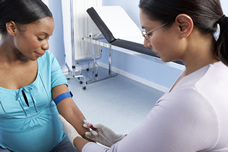
A blood sample identifies your blood group and tests for a range of conditions.
